|
|

National Film Studies
Overviews and Other International
 Directory of World Cinema: Australia & New Zealand Directory of World Cinema: Australia & New Zealand
Lealand Goldsmith & Geoff Ben
A valuable addition to the Directory of World Cinema series, this book offers an in-depth and exciting look at cinema produced in Australia and New Zealand since the turn of the twentieth century. Softcover, 345 pp. $29.95.
 The Faber Book of New South American Cinema The Faber Book of New South American Cinema
Demetrios Matheou
The first decade of the 21st century has seen a renaissance in South American cinema. This new generation of filmmakers has won prizes at major film festivals, been nominated for Oscars, and captured the imagination of audiences worldwide. This book features interviews with the most significant voices of this Latin new wave. Softcover, 421 pp. $30.00.
 100 Essential New Zealand Films 100 Essential New Zealand Films
Hamish McDouall
From the 1920s when Rudall Hayward produced his first astonishing films, New Zealand cinema has blazed a trail, pioneering new ideas, techniques and images -- and turning many directors, actors and cinematographers into international stars. For the first time, this beautiful book brings together and celebrates the industry's best, from startling shorts, to groundbreaking documentaries, to features that have taken the world by storm, won Oscars and become modern classics. Softcover, 267 pp. $31.95.
 World Cinemas, Transnational Perspectives World Cinemas, Transnational Perspectives
Natasa Durovicova & Kathleen Newman
The standard analytical category of "national cinema" has increasingly been called into question by the category of the "transnational". This anthology examines the premises and consequences of the coexistence of these two categories and the parameters of historiographical approaches that cross the borders of nation-states. The three sections of this volume cover the geopolitical imaginary, transnational cinematic institutions, and the uneven flow of words and images. Softcover, 368 pp. $41.95.
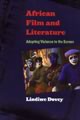 African Film and Literature African Film and Literature
Lindiwe Dovey
Against a detailed history of film's savage introduction and exploitation by colonial powers in two very different African contexts, this book examines the complex ways in which African filmmakers are preserving, mediating, and critiquing their own cultures while seeking a united vision of the future. Softcover, 334 pp. $40.50.
 South African National Cinema South African National Cinema
Jacqueline Maingard
South African National Cinema examines how cinema in South Africa represents national identities, particularly with regard to race. This significant and unique contribution establishes interrelationships between South African cinema and key points in South Africa's history, showing how cinema figures in the making, entrenching and undoing of apartheid. Illustrated throughout with excellent visual examples, this cinema history will be of value to film scholars and historians, as well as to practitioners in South Africa today. Softcover, 220 pp. $34.95.
 The Cinema of Australia and New Zealand The Cinema of Australia and New Zealand
Geoff Mayer & Keith Beatty
The Cinema of Australia and New Zealand celebrates the commercially successful narrative feature films produced by these two film cultures as well as key documentaries, shorts and independent films. This coverage also invokes issues involving national identity, race, history and the ability of two small film cultures to survive the economic and cultural threat from Hollywood. Softcover, 259 pp. $35.95.
 The
Pocket Essential Australian Film The
Pocket Essential Australian Film
Saskia Vanderbent
Australia has always been at the forefront of the film industry, giving birth
to the world's very first fiction and documentary features, and a host of international
stars, directors and first rate crews. This book analyses over 80 significant
works from silent through to contemporary cinema, considering their technical
innovation and recurring themes. The diverse range of films include The
History of the Kelly Gang, Walkabout, Picnic
at Hanging Rock, Mad Max, My Brilliant Career, The
Chant of Jimmie Blacksmith, Dead Calm, Shine, Rabbit-Proof
Fence, Chopper, Moulin Rouge and recent
controversial horror, Wolf Creek. Softcover, 160 pp. $9.95.
 Theorising
National Cinema Theorising
National Cinema
Valentina Vitali & Paul Willemen
Theorising National Cinema is a major contribution to work on national cinemas,
by many of the leading scholars in the field. It addresses the knotty and complex
relationship between cinema and national identity, showing that the nationality
of a cinema production company, and of the films it made, have not always been
seen as pertinent. Softcover, 326 pp. $33.95.
 Revolution!
The Explosion of World Cinema in the Sixties Revolution!
The Explosion of World Cinema in the Sixties
Peter Cowie
The period 1958-69 saw a brilliant explosion of talent in the world of
film-maiking. From France and Italy to India, Japan, Poland and Czechoslovakia,
young film-makers sprang from nowhere to challange the dreary conformity
of the fifties and flout the abiding taboos, both sexual and political,
of their age. Revolution! recaptures afresh the cultural
spirit of the sixties through a wide range of new interviews with those
maverick film-making talents of that time. Softcover, 286 pp. $21.00.
 Dreams
of a Nation: On Palestinian Cinema Dreams
of a Nation: On Palestinian Cinema
Hamid Dabashi
Over the last quarter century, Palestinian cinema has emerged as a major
artistic force on the global scene. Deeply rooted in the historic
struggles for national self-determination, this cinema is the single
most important expression of a much-maligned people. In Dreams
of a Nation, filmmakers, critics and scholars discuss the extraordinary
social and artistic significance of Palestinian film. As such, it
is, at the time of publication, the only volume of its kind in any
language. Softcover, 213 pp. $33.00.
 100
Bollywood Films 100
Bollywood Films
Rachel Dwyer
India's much-loved national film style, Bollywood cinema, is a veritable
genre unto itself. Fans of Bollywood will not want to be without
this informative screen guide, which reflects on 100 of finest films
in India's rich canon
of cinema: historically important films, cult movies, and box-office
hits.
Softcover, 258 pp. $24.95.
 Queer
Issues in Contemporary Latin American Cinema Queer
Issues in Contemporary Latin American Cinema
David William Foster
In this study of queer issues in Latin American cinema, David William Foster
offers highly perceptive queer readings of fourteen key films. He
examines each film in terms of the ideology of its narrative discourse,
whether
homoerotic desire or a critique of patriarchal heterosexism and its
implications for Latin American social life and human rights. This
book will be essential
reading for everyone working in queer studies and film studies. Softcover,
186 pp. $29.95.
 Mexican
National Cinema Mexican
National Cinema
Andrea Noble
Mexican National Cinema offers an account of the development
of Mexican cinema from the intense cultural nationalism in the aftermath of
the Mexican Revolution, through the 'Golden Age' of the 1940s and the Nuevo
Cine of the 1960s, to the renaissance in Mexican cinema in the 1990s. The book
moves from broad historical and theoretical contexts, particularly theories
of nation, emergent discourses of 'mexicanidad' and the establishment and development
of the Mexican industry, towards readings of key film texts and genres. Softcover,
224 pp. $39.95.
 Postcolonial
Images: Studies in North African Film Postcolonial
Images: Studies in North African Film
Roy Armes
Postcolonial Images is a comprehensive introduction to and
resource for cinema of the Maghreb. In clear and accessible prose, Roy Armes
examines the political and cultural context of films and the film industry
in the post-independence eras of Algeria, Morocco, and Tunisia. Softcover,
278 pp. $34.95.
 Beyond
Casablanca: M. A. Tazi and the Adventure of Moroccan Cinema Beyond
Casablanca: M. A. Tazi and the Adventure of Moroccan Cinema
Kevin Dwyer
In Beyond Casablanca, Kevin Dwyer explores the problems of
creativity in the Arab and African world, focusing on Moroccan cinema and one
of its key figures, filmmaker M. A. Tazi. Dwyer develops three themes simultaneously:
the filmmaker's career and films, filmmaking in post-colonial Morocco; and
the relationship between Moroccan cinema, Third World and Arab cinema, and
the global film industry. Softcover, 433 pp. $34.95.
 The Cinema of Latin America The Cinema of Latin America
Alberto Elena & Marin Lopez
The Cinema of Latin America focuses on the vibrant practices that make up
the traditions of filmmaking in this complex and diverse region. Through 24 individual
essays, that each consider one significant film or documentary, the editors of
this volume have compiled a unique introduction to the cinematic output of countries
as diverse as Brazil, Argentina, Cuba, Mexico, Bolivia and Chile. Softcover,
264 pp. $36.95.
 African Film: Re-Imagining a Continent African Film: Re-Imagining a Continent
Josef Gugler
Josef Gugler invites his readers to 're-imagine Africa' by examining
fifteen key films made by African directors and contrasting them with
two very successful films about Africa. The films serve to highlight
African directors' altogether different perspectives and introduce the
primary concerns and issues that they address. Softcover, 202 pp. $37.95.
 The New Brazilian Cinema The New Brazilian Cinema
Lucia Nagrib
Since the mid-1990s, Brazil has produced nearly 200 feature length
films. Many of these have been received enthusiastically by audiences
and critics, and have been released worldwide. This passionately argued
and illuminating book provides the first comprehensive critical account
of what is known as the "Renaissance of Brazilian cinema" and
demonstrates just how thought-provoking and inspiring Brazilian cinema
has become. Softcover, 296 pp. $36.95.
 Mexico City in Contemporary Mexican Cinema Mexico City in Contemporary Mexican Cinema
David William Foster
David William Foster analyzes how Mexican filmmakers have used Mexico City as
a vehicle for exploring such issues as crime, living space, street life, youth
culture, political and police corruption, safety hazards, gender roles, and ethnic
and social identities. Softcover 177 pp. $36.95.
 Third Take: Australian Filmmakers Talk Third Take: Australian Filmmakers Talk
Raffaele Caputo/Geoff Burton
Despite all of the scholarship pertaining to Australian cinema, there have
been no forums for those who actually make the films to discuss their own work
and the work of fellow filmmakers. Third Take gives filmmakers a voice,
allowing them to engage with the issues and concerns usually raised by journalists
and critics. Contributors include: Philip Noyce, Peter Weir, John Seale, Bill
Hunter and several others. Softcover 215 pp. $29.95.
Back to top
|
|